Sunday, March 17, 2013

Rarities this week


Observed this Great Northern Diver (Gavia immer) about 200 ms off Faro-beach this afternoon and got a few digiscoping record shots (the photos enlarge when you click on them). It was after a rain shower and the sea was almost flat. A big flock of c. 150 Common Scoter was nearby and I also saw a single Razorbill passing by, as well as two or three Great Skuas later on. The diver fished with success and when the wind picked up, I could not relocate it anymore.


This Cream-coloured Curser (Cursorius cursor) is present since almost 10 days now at the Alvor-Estuary in the west-Algarve, where I saw and photographed it on Monday. This is only the 7th record for Portugal of this marvellous bird species. We had strong, constant southerly and south-westerly winds before for many days, that might have carried this inhabitant of deserts and semi-deserts from Marokko or the Canary Islands, where it breeds. Some years ago an influx into south-east Spain had let to breeding/breeding attempts there, but since then there are no signs of colonisation of the continent anymore.


Thursday, January 17, 2013

Preparing for spring

These photos were taken last week up in the Alentejo plains. At this spot - the Portuguese call these open Holm-oak woods "Montado"- we observed a Black-winged Kite and a flock of Stock Doves (Columba oenas). A small group of 11 Common Cranes were only about 1 km away from there and we were able to watch them closely. Red Kites are literaly soaring everywhere in the area during a winters day, one of them did so accompanied by a young Golden Eagle (Aquila chrysaetos).

A pair of Spanish Imperial Eagles (Aquila adalberti) digiscoped in the morning mist. This is a pair of subadults. Note the  heavier built of the female perched below. Photo: GS


Later, we had more and good observations of the Spanish/Iberian Imperials, soaring, when the thermals had formed. At one occasion, we watched three birds close together and interacting with each other.
Great Bustards where numerous and we must have seen over one hundred of them throughout the day. Little Bustard was more difficult to spot, we found a small group of six and watched them with the scope, the male moulting into breeding plumage now.

A group of male Great Bustards (Otis tarda). Alentejo, Portugal, January 2013. GS.

Sunday, September 23, 2012

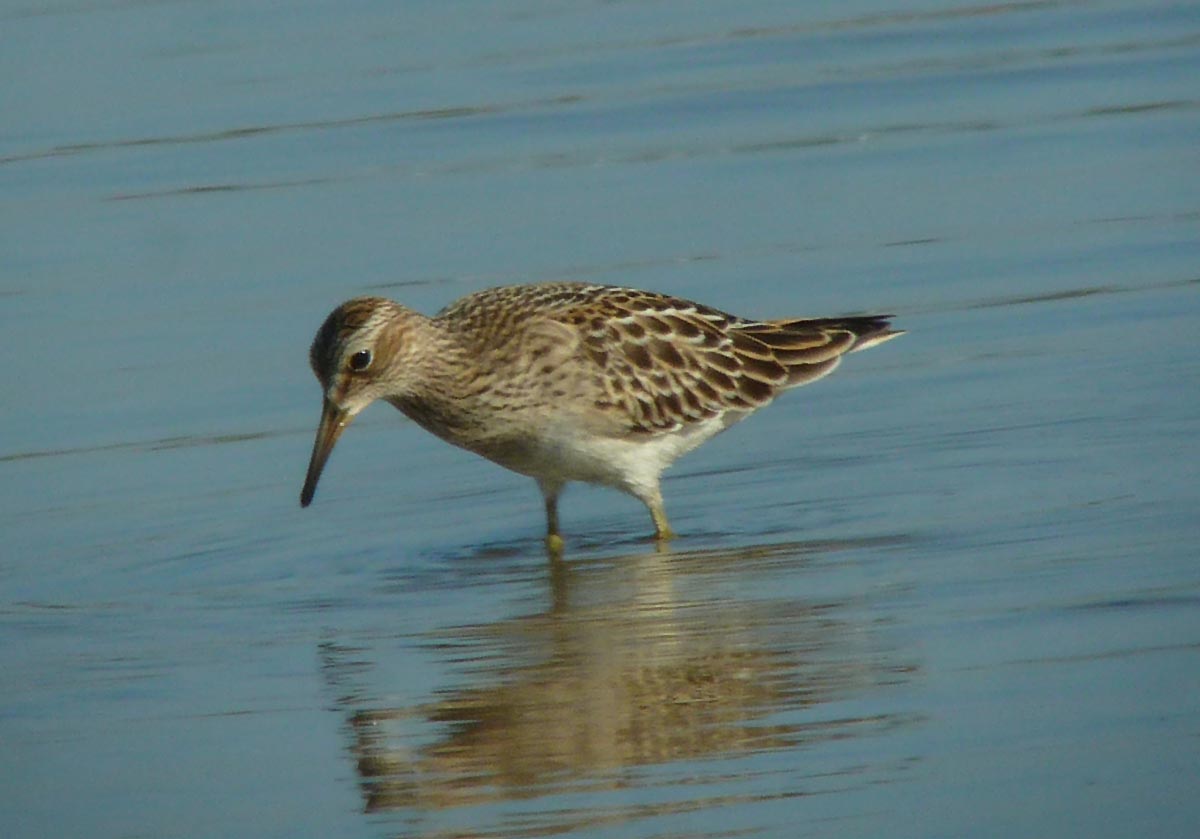
Pectoral Sandpiper (Calidris melanotos)


This juvenile Pectoral Sandpiper (Calidris melanotos) has been present from last Sunday (16.09.) to at least Thursday (22.09.) at Lagoa dos Salgados (Silves), where I photographed it when it was feeding close to the watchpoint together with Dunlins, Sanderlings, Curlew Sandpipers and Little Stints. The bird was found by my friend and colleague João Ministro when he visited the lagoon with a group of Portuguese birdwatchers.

Sabine's Gulls where among the highlights of the 3 Pelagic trips I organized this past week, 6 birds on Tuesday, 18th and at least 4 birds on Saturday, 22nd (off Fuseta). Also 5 species of Shearwaters, two species of Storm-Petrels and 3 species of Skuas have been seen during the trips, among others. I add a video of a Great Shearwater I made on Tuesday here: Great Shearwater off Fuseta, September 18th

Today it rained and so the summer draught will soon disappear hopefully. Migration is strong underway, on the cape of Sagres as well as everywhere along the coast. Black-winged Kite, Osprey and Booted Eagle were around in Ludo (Faro) yesterday.


Friday, August 31, 2012

Summer

Spanish Imperial Eagle (Aquila adalberti) immature, 2nd cy, near Mértola. 30th of May 2012. Foto: Gaby Dienst.

... is almost gone now. Autumn migration (or postnuptial migration) has begun weeks ago, with Bee-eaters and Red-rumped Swallows still passing through in good numbers. Last week, Willow Warblers where most abundant here and also the first Pied Flycatchers appeared.
On a trip to the Cape of Sagres and St. Vincent earlier this week (28-08), we saw a first Whinchat and Short-toed Larks and Tawny Pipits could be found in the open and still dried out countryside. Spectacled Warblers where still around and we also found a group of Little Bustards. Two of apparently three Egyptian Vultures in the area gave good views and a thermal of close to 30 Black Kites (mostly juveniles) was impressive to watch. A juvenile Monatgu's Harrier, two Short-toed Eagles, Peregrine and many Kestrels where other raptors found in the area. Further inland, we found a good flock of the local resident Red-billed Choughs, feeding around a  farm. A chat with a friend, employee of "Strix", the company responsable for surveying the area around the wind turbines between August and November, revealed that Black Stork, Osprey, Honey Buzzard, Eleanora's Falcon and European Roller already had been seen here over the days before.

Around Faro last week, Black Terns (2 ad., 1 juv.) were present at the E.T.A.R. east of Faro, as well as a Wood Sandpiper, an ad. male Ruff, at least nine Glossy Ibis, many Common Sandpipers and Yellow Wagtails (M.fl. iberiae and flava) and a Melodious Warbler (on Aug 20th). Little Bittern, including the fledged juveniles, some still with some dune feathers on top of their head, are easy to spot now near the hide at Quinta do Lago. Booted Eagles are also back (well, this year I have observations from late May and July for the place...) and Black-shouldered Kite roosts in the area.
Another friend, Thjis from RIAS (Olhão) is currently ringing in a reedbed in Ludo and caught Reed- and Sedge Warblers, Subalpine Warblers, Willow Warblers, Common Waxbills and also the occasional Western Orphean- and Grasshopper Warbler during the past 10 days or so. I went to visit him there with my son Lukas one morning, who enjoyed it a lot beeing so close to the birds and asked me to go again afterwards.

Even though the inland "steppes" are terribly dry and quite hot on most days in summer, they always "work" and particular raptors are present also during the hot season. in late May/early June I have been visiting this region with a group of German birders. A selection of photos from this trip (8 days-Algarve & Alentejo) is here Birdingtours 26.05 -02.06.2012 (worth having a look!) thanks to Gaby Dienst, who took most of the photos and kindly allows me using them here. The main target species were White-rumped Swift, Rufous Bush-Robin, Red-necked Nightjar, European Roller, Collared Pratincole, Western Orphean Warbler and other, rather elusive summer birds, which we all got during the trip, around 145 species in total.
In early August, in the Alentejo plain, European Roller was still present and on August 18th, about 30 Griffon Vultures, 2 Black Vultures, an immature and an adult pair of the Spanish Imperial Eagle could be watched, the latter one, when attacking a Short-toed Eagle (on passage) when flying over the group of trees they were roosting in. An immature Bonelli's Eagle, as well as several Booted Eagles and still some Lesser Kestrels were seen the same day, as well as quite a few Black-eared Wheatears and a first Northern Wheatear.

Finally, out on the sea we encountered about 6 to 8 Wilson's Storm Petrels and about a dozen "Europeans" about 5 miles off Fuseta last Tuesday (21-08) and Rui Caratão, who joined the trip, got some nice shots which I can share with you here:
http://gullsinlusitania.blogspot.pt/2012/08/wilsons-storm-petrel.html
Delightfull were also the Bottlenose Dolphins that joined us on our way returning back to Fuseta. I took a small video here:
http://youtu.be/jKE_okayGAU

Over the next weeks, quite a few pelagics are scheduled, 7th, 8th and 9th of September, with vacancies still for the 7th off Fuseta and the other two days sold out. Many Tours are scheduled for the peak migration in September and October and I will be Guiding groups from Sweden, Swizzerland and England, as well as a group of International Tour Operators invited on behalf of the Algarve Toursim Board. I am also going to spend some days at the Strait of Gibraltar (around Tarifa) - the migration hot spot in Iberia.

Até breve!/See you soon!/Bis bald!

Thursday, July 19, 2012

Visit to the sea canyon

This past Sunday, July 15th, we sailed out from Portimão with the new catamaran of Ecoceanus. Calm sea, sunny weather and a lot of activity out there, between about 8 and 13 miles off shore. One of the highlights of the trip were sightings of two Minke Whales (Baleonoptera acutorostrata) one time as close as about 40ms to the boat.

Regarding birds, we had a very good selection of pelagic species already - have a look of the species list:

Good views of Great- (c. 8), Arctic- (2) and Pomarine Skuas (3), Great- (2), Sooty- (1-2), Balearic- (30+) and Cory's Shearwaters (c. 60), Wilson's- and European Storm Petrels (40+, mainly O.o.)... 

Next trip is scheduled for the 19th of August and there are still seats available. Don't miss the oportunity!

Minke Whale (Baleonoptera acutorostrata) off Portimão. Photo: GS.


Here is a video I shot during a trip to watch Dolphins off Fuseta with Passeios Ria Formosa in early July. My first encounter with Striped Dolphins (Stenella coeruleoalba) here!


Wednesday, June 27, 2012

Sabine's Gull (Xema sabini) and others

This morning, we went out on the first boat-trip of the season - and saw some cracking birds!
Adult Sabine's Gull (Xema sabini) c. 6 miles off Fuseta today
   
About six miles off Fuseta, we found an adult Sabine's Gull, following a small fishing trawler, feeding on the surface in a "light-winged" and elegant manner, next to two Wilson's Storm-Petrels (Oceanitis oceanicus) "dancing" on the water. Many Cory's Shearwaters (Calonectris diomedia) were patrouilling around the vessel and single Manx Shearwater (Puffinus puffinus) passed close along the side of our boat, in fast and direct flight. One Great Skua (Stercorarius skua) flew over and we had several groups (about 40 Ind. in total) of Northern Gannets (Morus bassanus) all moving west - almost exclusively birds in 2nd summer plumage, exept two of the third year. On the way out, we had already seen three, plus one single Balearic Shearwaters (Puffinus mauretanicus) crossing in front of the boat (west). A probable Sooty Shearwater (Puffinus griseus) was a bit too distant to be absolute certain about the ID (well, I was, actually...) and two distant Terns were probably Common Terns (Sterna hirundo). Also two more Petrel sp. remained unidentified. On the way in, we saw the first Audouin's Gull (Larus audouinii) and found about 10 Ind. more on a sandbank inside Ria Formosa, close to the harbour of Fuzeta, next to Sandwich- and Little Terns.

The same Ind. in flight. Photo by Denis Keitel - thanks for sharing! 

In Portugal, there are no acknowledged records of Sabine's Gull in June so far. Most birds are seen in late autumn and winter on southbound migration along the west coast in recent years. An adult bird still around here as late as now, will most likely not successfully nest this year, high up in the Nearctic region, were it origins.

Here are further dates for Pelagic boat-trips already scheduled so far - join in!

July,15th; 
Aug., 19th;
8th., 9th. and 20th September 2012 (all Portimão); 
7th,18th and 22nd September 2012 (Fuseta); 
11th October 2012 (Fuseta)

Trips from Fuseta are 40 €  p.p. now, further info here.
Info about the trips off Portimão is here.

I will be on board as a guide.

P.S.: Talking about pelagic species: A Humpback Whale (Megaptera novaeangliae)- very rare here, entered Ria Formosa, just south of Faro yesterday, 5th of July 2012. What an impressive animal!

Watch the video here:  Humpback Whale near Faro