Saturday, February 5, 2011

Rock Pipit


Rock Pipit (Anthus petrosus) in the harbor of Sagres today (05-Feb. 2011). A Rock Pipit (this one?) had been reported from this location some weeks ago. Not an easy one to distinguish from Water Pipit (A. spinoletta) in some cases. Both species were formerly seen together as the "Water Pipit-complex". This individual is rather untypical on the first look, a bird of the "Scandinavian" subspecies littoralis. Note the very long bill, the short supercillium, which does not continue behind the eye, dark-grey mantle and the dull underparts, which are diffuse and heavily streaked. I could not see the outer tail feathers. But most of all I found that the call was loud and sharp (accentuated) and sounded clearly different to the weaker and diffuser call of Water Pipit or anything I have ever heard from the latter species. An interesting article about the former "Water Pipit-complex" is here http://www.ntbc.org.uk/water and rock pipits.html - scroll down to the end of the page to see some similar Rock Pipits to this one here. Today, two Rock Pipits have been reported from Sagres harbor (and a Purple Sandpiper Calidris maritima, a species that I have found there with a Birdwatching-group this past December) - the photo I saw of the Rock Pipit today, showed a different, more typical Individual (all dull and dark). Yesterday, a Slavonian Grebe (Podiceps auritus) has been found and photographed in Ria Formosa just south of Faro, but I could not find the bird there this morning and it seems it has passed on. It is a species I have never seen in Portugal so far. There is also still a Goosander(Mergus merganser) present in the Alvor-estuary near Alvor. Just no Waxwings so far... :) but there has been a record in the 1960s in Portugal !

Saturday, January 22, 2011

Flowers


Almond blossom. A few days ago, just out my front door. Barn Swallows (Hirunda rustica) are arriving and Hoopoes (Upupa epops) and Serins (Serinus serinus) are singing. Also some of the wintering birds from the north sing - Robins, Blackcaps, Song Thrushes and Common Chiffchaffs.

Tuesday, January 11, 2011

Digiscoping - experimenting new cameras


I am using the Leica Apo-Televid 77 Telescope since about 10 years now and I am still very happy with it. It is a great Telescope. For digiscoping, I used the Nikon Coolpix 995 and a handmade adapter so far which worked very well until finally now the camera has a defect. I was looking for something new anyway, since it had only a 3 Mega pixel sensor, it is a camera from the 1990s. The photo series above are made with a Panasonic Lumix DMC-F4 near Faro this morning - the photos are not bad, but also still not what I expect.... so I guess I have to keep on looking !
This color-ringed Eurasian Spoonbill (Platalea leucorodia) by the way is an almost 14 years old bird from the Netherlands (like a lot of Spoonbills we see here) and seems to winter since at least 10 years here in Ria Formosa. I have reported it already almost exactly 4 years ago from the same location. The life/history of the bird I received suggests also, that it migrates crossing through the Iberian Peninsula. If you ever see a color-ringed Spoonbill and can get the color-ring combination or the code, please send a photo or detailed description *including location, date, observer etc.) to o.overdijk[at]home.nl or visit this page (in Dutch) about the ringing program here: http://www.werkgroeplepelaar.nl/fotos.htm


These two digiscoping shots of a Booted Eagle (Aquila pennata) are made here some days ago with a Canon Powershot SX130 IS. The camera has a 12x optical zoom and 12 Megapixel (like the Lumix) but produces a horrible lot of vignetting when used at the telescope... no option, really...
All photos are processed with photo shop by the way (crop, sharpen, sometimes reducing noise, contrast, lightness etc. correction, but moderate... I usually avoid changing things like saturation or hue.

Thursday, January 6, 2011

Alentejo impressions


Baixo Alentejo, 2011-05-01. Photo: GS

Springtime here in South Portugal begins just after Christmas, is what I usually say and it is true. Serins (Serinus serinus) and Spotless Starlings (Sturnus unicolor) are singing outside, and the first Bees and Butterflies are visiting the flowering meadows. In the Alentejo, the vast inland open Oak woods and grasslands of South Portugal, Calandra Larks (Melanocorypha calandra) and Corn Buntings (Milaria calandra)are singing, while the fields are full of Golden Plovers (Pluvialis apricaria) and Lapwings (Vanellus vanellus) and Red Kites (Milvus milvus) are circling above the scenery, to name but a few common species.


The area is a great place to observe raptors. 2011-05-01. Photo: GS

Yesterday, observations of a Spanish Imperial Eagle (immature) close together with an adult Bonelli's Eagle, have been among the highlights of the trip. But also well a dozen Black-bellied Sandgrouse (Pterocles orientalis) in total gave good views. Spring has only begun, and the Alentejo will be full of flowers until around mid May. In the next weeks, the first migratory birds, like the Great Spotted Cuckoo (Clamator glandarius) will arrive here, while such elusive bird species as the Rufous Bush Robin (Cercotrichas galactotes), European Roller (Coracias garrulus) and White-rumped Swift (Apus caffer) will only come back from tropical Africa around mid April or even in May.


The Great Bustard (Otis tarda) is the emblematic bird of the Baixo Alentejo grasslands. Thanks to the successful conservation programs run by the Portuguese NGO "Liga para a proteçaõ da Natureza" (LPN) in the area, this magnificent birds and other "steppe" birds are increasing again but distribution is very local.

Some people call the area the Paradise in Portugal and it is a fantastic place for birdwatching without any doubt, recently ranked on 37 of the best Birdwatching destinations worldwide by the American Birding Association (ABA) here: http://blog.aba.org/2010/12/2010-top-40-the-birding-year-in-review-part-1.html#tp I met the author, Ted Floyd, on the Birdwatching Festival in Sagres in October 2009, when I was guiding a group of journalists and tour operators on behalf of the Algarve eco tourism company Sunquays. The event had been organized by the Tourism board of the Algarve.

Tuesday, January 4, 2011

2011 - Birds, birds, birds !

Wishing everybody a good year 2011 - healthy, happy, successful, prosperous and full of good birdwatching, of course !

Today has been an incredibly sunny day here around Faro, with temperatures close to 20 degree C and hardly any wind. The birds of prey liked it - Common Buzzards (Buteo buteo) performed display flights, "miauing" high above the Umbrella Pines and I counted a total of six Booted Eagles (Aquila pennata) in the area. Three Black-winged Kites (Elanus caeruleus) were also present.
In the afternoon, another Black-winged Kite was feeding on his catch on a telegraph post near Vilamoura, a couple of Marsh Harriers (Circus aeruginosus) was hunting nearby. Flocks of Spanish Sparrows (Passer hispaniolensis), lots of Corn Buntings (Milaria calandra) and a mixed flock of Lapwings (Vanellus vanellus) and Golden Plovers (Pluvialis apricaria) roosted on an acre.


Black-winged Kite (Elanus caeruleus) in Vilamoura today. Photo: Georg Schreier.


Extensive reed-beds in Parque Ambiental, Vilamoura. Photo: Georg Schreier

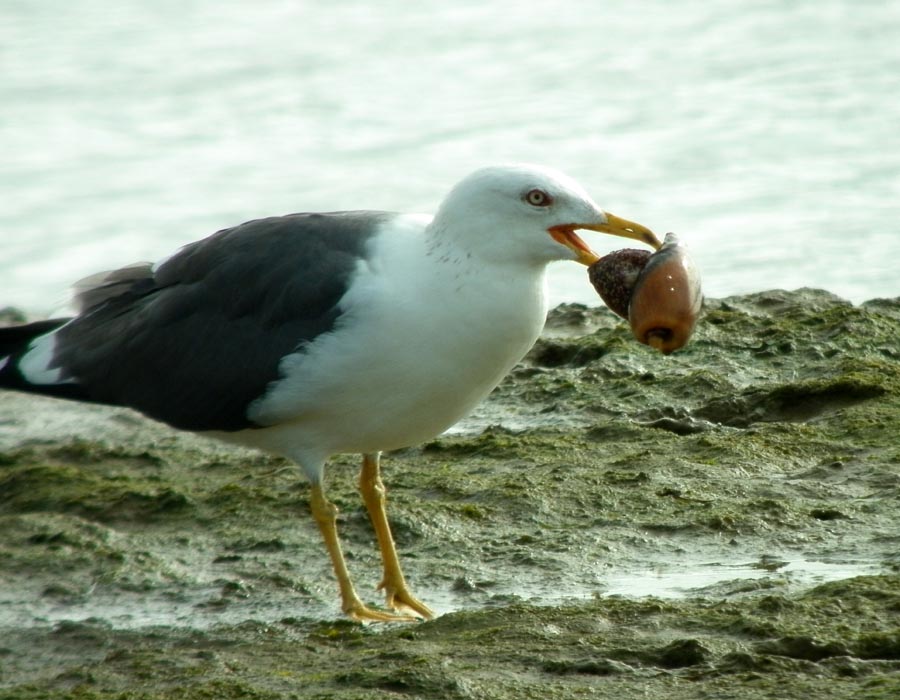
In the Marina of Quarteira, an adult Greater Black-backed Gull (Larus marinus) was easy to find, sitting on his favourite boat-Cabin again. I observed this bird there a month ago already, and probably the same Ind. the previous winter. An Irish Birder visiting the Algarve from time to time - we have been runing into each other already years ago, in Ludo, where he had just found a Baird's Sandpiper (Calidris bairdii), photographed another, ringed adult there recently. He also made a great capture of a flock of Common Scoter (Melanitta nigra) just before I arrived near the Marina with a Birding group, also seeing these birds.


Adult Greater Black-backed Gull (Larus marinus) in Quarteira today. Photo: Georg Schreier.


Adult Greater Black-backed Gull (Larus marinus) with rings. Photo: Michael Davies.


Flock of 47 Common Scoter (Melanitta nigra), Quarteira, 2009-12-11. Photo: Michael Davies. There is just one adult male in the whole flock. Click on the picture to enlarge. Thank's Michael for sharing - a great shot, I really like it, it remembers me on one of the best observations during that afternoon !

Yesterday I observed an adult male Little Bittern (Ixobrychus minutus) close to the observatory at the São Lourenço Golf-Course, a Glossy Ibis (Plegadis falcinellus) was foraging close by, next to the ever present Azur-winged Magpies (Cyanopica cooki).
An apparently adult female Goosander (Mergus merganser) currently present at the Alvor-estuary (near Lagoa, west Algarve) is the first record of this species for the Algarve and not the only one in Portugal and Spain at the moment. Not a must for us being used to see these birds wintering further north but definitely a good Algarve tick.

Monday, December 13, 2010

Grey "Little Egret"


Presumed hybrid Little Egret (Egretta garzetta) X Western Reef Heron (Egretta gularis) at Salinas de Santa Luzia (Tavira) on December 12. These birds are seen with regularity in the Algarve and Southern Spain and these type of birds has been discussed in articles in "Dutch Birding" and the website "Rare birds in Spain". The "cave" is, that dark morphs of both species do exist as well.
Lenght and shape of the bill is said to give some indications in this case, among others, as far as I remember, but I did not have the time to look it up yet. This has been only yesterday and I just arrived home now from an excursion with a secondary school class from Faro in Ria Formosa Natural Park to observe birds and talk about (and show!) biodiversity and trophic chain etc.
Voluntary work, by the way ... ;)


Another bird. Little Egret X? This photo is from Febr. 2007 and has been made at a small pool in the salt marsh just behind "Forte do Rato" in Tavira. Perhaps a 2nd or 3rd generation hybrid ?

Friday, November 26, 2010

Resume of the past 7 days Tours


Looking out on the plain of the lower Alentejo - all turning green now.

So, what is there to tell about the recent Birding-Tours here in the Algarve and into the Alentejo ?
Well, a lot ! Bird life has been fabulous - plenty of birds and good species !

Yesterday, 25-11, during a Tour around Faro, both, Sacred Ibis (2 Ind.) and Glossy Ibis (1 Ind., very close views) could be observed, as well as Purple Swamphen and a late male Little Bittern (Ixobrychus minutus), Black-headed Weavers (Ploceus melanocephalus), Black-necked Grebe (Podiceps nigricollis), a couple of Common Shelduck (Tadorna tadorna) and various wintering Duck-species in large numbers were present. We also watched a flock of close to 1000 Black-tailed Godwits (Limosa limosa) feeding in a drained salt pan together with Pied Avocets and many other wader species. Among the birds of prey, Osprey (Pandion haliaetus), Marsh Harrier (Circus aeruginosus), 8 Booted Eagles (Aquila pennata) and a Black-winged Kite (Elanus caeruleus) could be added to the day list.

On Tuesday, the 23rd, we did a two and a half hours pelagic boat-trip out to the sea from Fuzeta (east Algarve). Despite the rainy weather (the boat has a cabin fortunately) it has been a successful Trip. We saw at least 50 European-Storm Petrels (Hydrobates pelagicus), 2 Balearic Shearwaters (Puffinus mauretanicus) lots of Great Skuas (Stercorarius skua)- at least 15 Ind, sometimes 5 around the boat at the same time, roughly 250 Northern Gannets (Morus bassanus) including many adults now, including 1 bird almost colliding with the boat when we approached a trawler about 6 Miles out... A new species for the year-list but not completely surprising, was a single Atlantik Puffin (Fratercula arctica) diving and then taking off close to the boat. We also saw a distant school of Dolphins (probably Common-) which we did not approach, because we were just "chasing" the seabirds at this moment, plus an Ocean Sunfish (Mola mola) next to the boat.

The day before, Monday, the 22nd of November, I went to the Baixo Alentejo with a party of people. We found all the main target-species during the morning, including several groups of Great Bustards (Otis tarda), a feeding flock of 70+ Little Bustards (tetrax tetrax), small groups of Black-bellied Sandgrouse (Pterocles orientalis) flying and a flock of around 100 Common Cranes (Grus grus). From a hillside, we spotted 14 Griffon Vultures soaring in a thermal at quite a distance - a rather late date for this species here. A single Black Vulture (Aegypius monachus) was with them and an adult Bonelli's Eagle (Aquila fasciata) also joined the soaring birds for a while.
Earlier in the morning, we had already watched a juvenile Spanish Imperial Eagle (Aquila adalberti) perched on a pile of stones, presumably his night-roost, with the telescope, as well as a Black-winged Kite (Elanus caeruleus) hovering next to the road.
On our way back, we stopped at a lagoon on the coast, where we had excellent views of Bluethroats (Lusciana svecica) and also saw various waders and other aquatic birds, including Glossy Ibis, as well as Caspian Tern (Sterna caspia) and Mediterranean Gull (Larus melanocephalus).

The Friday before (19th) I had been on a Alentejo-Tour already which has been just as good and also included all the main target species, with some slight differences. We did not get any Vultures, but observed two immature Spanish Imperial Eagles (Aquila adalberti) close together on the ground, where they were competing about a small carcase. One bird showing heavy moult in the primaries and the pale and streaked plumage on both indicated, that they were in their 2nd or 3rd year. Besides the numerous Red Kites (Milvus milvus) in the area, we also saw a juvenile Hen Harrier (Circus cyaneus) and observed a hunting Peregrine Falcon (Falco peregrinus) which caused quite a panic among the present Lapwings, Black-bellied Sandgrouses and Golden Plovers.

Recent sightings from the west-coast of Portugal suggest that we might get another good winter for North Atlantic Gulls and wintering Passerines here - Let's hope so !


Drake Teal (Anas crecca) almost in full breeding plumage. Faro, 23rd Nov 2010.