Wednesday, August 26, 2020

Dragonflies in the Algarve

This summer, I went somewhat deeper into exploring the dragonflies of the Algarve. Portugal is home to close to 70 species, the majority of which can be found here in the south. This includes several species restricted to Iberia- and a few areas around the Mediterranean. Namely dragonflies of African origin have begun colonising southern Europe in the last years and decades - some, like the Broad Scarlet (Crocothemis erythraea) have long reached central Europe. Violet Dropwing (Trithemis annulata) is already among the commenest dragonflies here and is found in rocky pools or river sections (most rivers and streams dry out at least partly here in summer) in hot areas with less vegetation. It shares habitat with its sibling species, the Orange-winged Dropwing (Trithemis kirbyi) first recorded in Portugal only in 2016 (link) so one of the most recent additions to Portugals Odonata -Fauna. I was surprised finding it at more than half a dozen different- and new locations in the central- and eastern Algarve over the past two month! So spreading rapidly, it seems. Another speciality we have here in the Algarve is the Ringed Cascader (Zygonyx torridus) known to occur in Portugal only at one single spot in the west Algarve, were we found it easy to see but difficult to photograph. I include here a number of photos taken during the past weeks. The camera I used is a small travel zoom camera from Panasonic with Leica optics: Panasonic DMC-TZ70 in macro mode. Birds are still my specialty but I like not to be ignorant of the many aspects of wildlife we encounter when being in the field.

Orange-winged Dropwing (Trithemis kirbyi) mature male. Alcoutim, 31-July-2020. All photos: Georg Schreier.


Orange-winged Dropwing (Trithemis kirbyi) mature male. Serra de Tavira, 21-Aug-2020. 


Violet Dropwing (Trithemis annulata) mature male. Serra de Tavira, 21-Aug-2020 .


Violet Dropwing (Trithemis annulata) mature male. Serra de Tavira, 21-Aug-2020 .


Violet Dropwing (Trithemis annulata) female. Alcoutim, 31-July-2020 .


Long Skimmer (Orthetrum trinacria) mature male. Alcoutim, 31-July-2020.


Epaulet Skimmer (Orthetrum chrysostigma) male. São Brâs de Alportel, 21-June-2020.
Ringed Cascader (Zygonyx torridus) west Algarve, 08-Aug-2020.


Ringed Cascader (Zygonyx torridus) copulation. Western Algarve, 08-Aug-2020.


Large Pincertail (Onychogomphus uncatus) female. São Brâs de Alportel, 14-July-2020.


Small Pincertail (Onychogomphus forcipatus) male. São Brâs de Alportel, 14-July-2020.


Lesser Emperor (Anax parthenope) Quinta do Lago (Loulé), 19-July-2020


Blue Emperor (Anax imperator) ovipositing. Serra do Caldeirão, 21-Aug-2020.


Copper Demoiselle (Calopteryx haemorrhoidalis) female. Loulé, 25-August-2020. A few streams in the limestone belt (Barrocal) of the Algarve have running spring water throughout the year.


Copper Demoiselle (Calopteryx haemorrhoidalis) male. Near Loulé, 25-August-2020. 


[Post edit:] Today (Aug., 27th) on the bordwalk back from Faro-beach, we noticed several large brown dragonflies hovering above the dunes and salt marsh (c. 20 Ind. in total) and I managed to get this record shot of one Ind. perched: Vagrant Emperor (Anax ephippiger) female. Amazing! This was a migratory event and they were apparently heading north!


[Post edit] Northern Banded Groundling (Brachythemis impartita) female perching on the golf green. The darker male in the photo above. Quinta do Lago (Loulé), 06-Sept-2020.

[Post edit] Black Percher (Diplacodes lefebvrii) male. Serra do Caldeirão, 29-Aug-2020.


Red-veined Darter (Sympetrum fonscolombii) mature male. Foia / Monchique, 08-August-2020. A dragonfly known to every birdwatcher here. At the cape area of Sagres, it can be extremely numerous during autumn (bird) migration, sometimes reaching hundred thousands (!) of Ind./day in the area, on northbound migration.


Sunday, August 16, 2020

Pelagic boat trips


Cory's Shearwater (Calonectris borealis) and Sooty Shearwater (Ardenna grisea) taking off. About 2 miles off Ilha da Culatra, Algarve, 22-July-2020. All photos: Georg Schreier.
Cory's Shearwater (Calonectris borealis) and Sooty Shearwater (Ardenna grisea) taking off.
About 2 miles off Ilha da Culatra, Algarve. 22-July-2020. All photos: Georg Schreier.

One of the best nature activities to do in the hot season here, is going out on a refreshing boat trip, exploring the coastal waters of the Algarve for pelagic sea birds. An activity, which I am doing here in the "Sotavento" (Algarve's sandy eastern half) with a boat tour operator from Fuseta for more than 10 years now. Between June and October, we can see up to six Shearwater-species, at least two species of Storm Petrels (Wilson's- and European-) and various other pelagic sea birds, including Skuas (mostly Great-, but also Pomarine- and Arctic-) Nothern Gannets, Terns and Gulls, including Audouin's and Slender-billed Gulls on a regular basis. Also Dolphins (mostly Bottlenosed- and Common-) are often encountered during these short trips (duration: 2,5 hs) when we go out in a spacy glass fiber boat for up to 6 miles. Each trip is different and what we see depends a lot on season, as well as on weather- and wind conditions. I include here photos from the two last trips (Aug. 12th and July, 22nd this year). Minimum number we require to go out are 4 people. We don't do "chumming", but look for areas with feeding activity or for roosts. We are going to do one trip each week till early September (Sept. 2nd.) for now. For further Info and reservations visit: http://www.birdwatching-algarve.com/pelagic-boat-trips.html

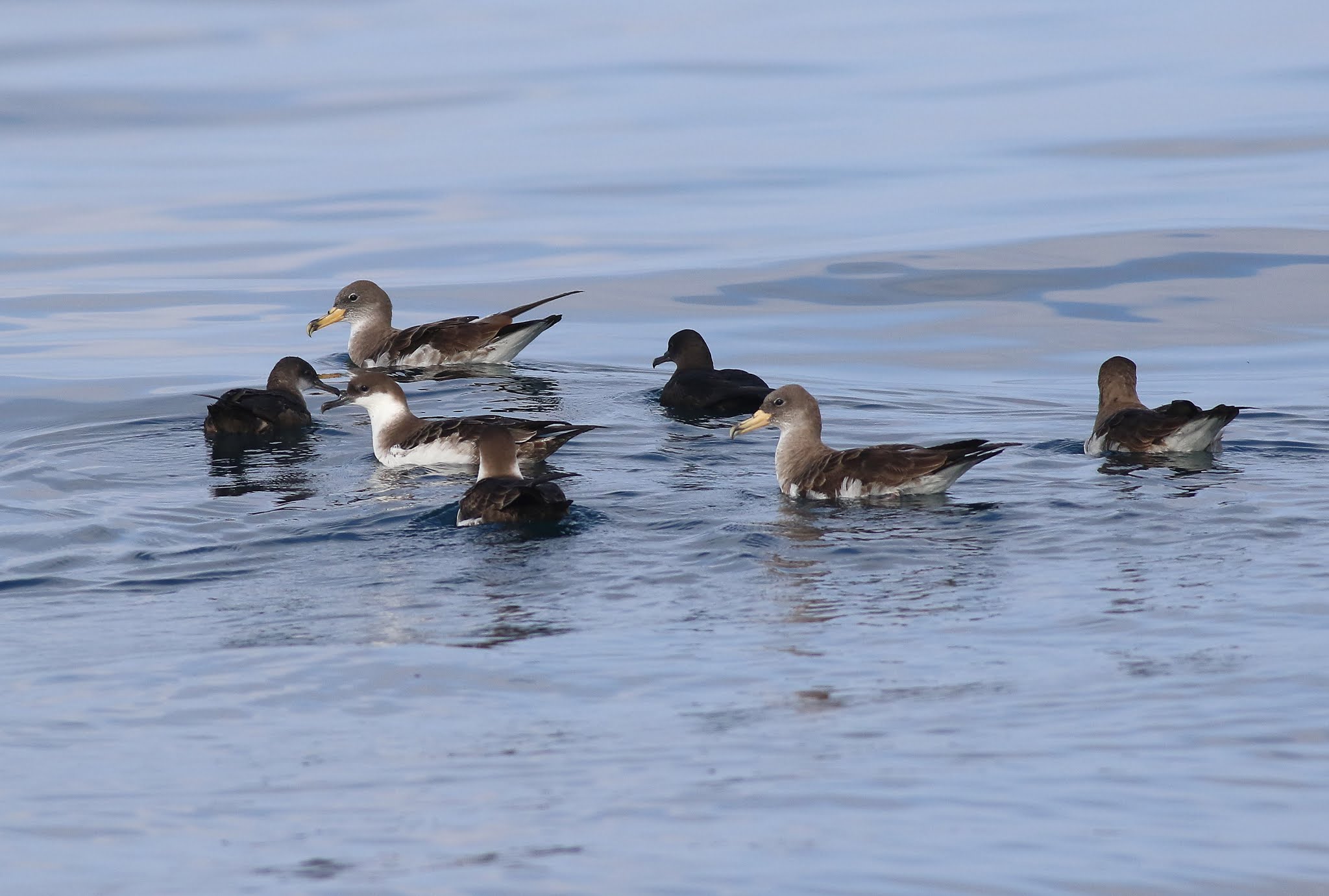
A nice "grouping" of Shearwaters: Balearic Shearwater (Puffinus mauretanicus) on the left. Two Great Shearwaters (Ardenna gravis) to the right of it. A Sooty Shearwater (Ardenna grisea) in the center back. With three Cory's Shearwaters completing the mix... off Fuseta, Algarve, 22-July-2020.


Wilson's Storm Petrel (Oceanites oceanicus) in fresh plumage, passing close by the boat. Amazing, these little sea birds breed around the Antarctic and spend the south winter in our area. About 5 miles off Fuseta, 12-Aug-2020. The birds in the following three photos are of the same species.


The Storm Petrels were feeding around a floating and deteriorating carcass of a Dolphin, we encountered a few miles off shore. Also a small Shark (possibly Blue-) was taking bites...


European Storm Petrel (Hydrobates pelagicus) showing active wing moult, growing inner primaries. 12-Aug-2020.


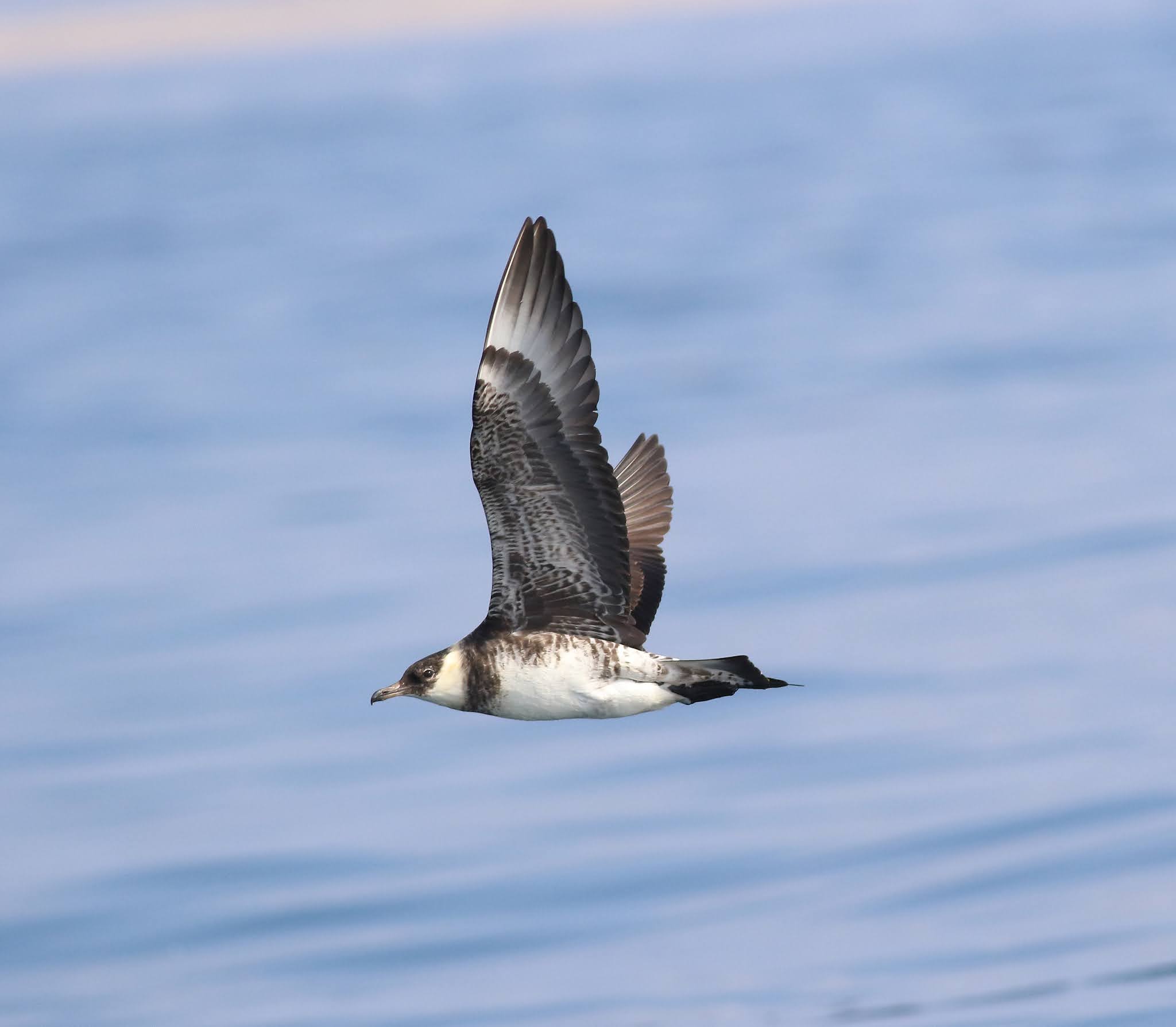
Pomarine Skua (Stercorarius pomarinus) light morph, 2nd summer type, roosting with Cory's Shearwaters. Off Fuseta, 22-July-2020. The next two pictures showing the same bird.


Manx Shearwater (Puffinus puffinus) taking off. 22-July-2020. One of the rarer species here in summer.


Bottlenose Dolphins (Tursiops truncatus) with a calf. 22-July-2020. In June we were lucky enough to see Risso's Dolphins (Grampus griseus) during a trip off Fuseta: Here is a short video:  https://youtu.be/cTqI1DlffEs  [post edit: two videos of Common Dolphins I made during a trip on 21-Aug-2020 are here and here ]

Next trips are scheduled for Sept., 17th and Sept. 29th, 2020.

Monday, June 15, 2020

Yellow-crowned Night-Heron

Earlier this month, I did the first tours after the "lock down" here in the Algarve. The wetlands around Faro (Ria Formosa Natural Park mainly) and to the Baixo Alentejo "cereal steppes", with a Dutch birder and WP-lister. Among the main target species was the Yellow-crowned Night Heron (Nyctanassa violacea), a mega-rarity (first for continental Europe) from the south-eastern US, that had been discovered in the marina of Faro on the morning of the 19th of May, where it was feeding on green crabs Carcinus maenas (e-bird checklist). The species is mostly nocturnal and crespuscular (hence the name!) and during the day, it was roosting nearby, perched in trees of a town square next to the marina. It was last seen about 3 kms further east, in a tidal channel next to some sewage works on June, 7th (for now). I had already seen and photographed it on the day of its discovery and we managed to get good and close views of the bird foraging and roosting on the morning of the first tour. I include here some photos I took during the tour, as well as the list of total of WP-records and some general Info on the species. By the way, this bird has likely crossed the Atlantik "ship assisted", as has been proved in similar cases before and is not identical with an adult of the same species observed on Horta, Azores, in early April this year (e-bird checklist) as plumage details reveal (advance of yellow crown coloration, lenght of crown- and back feathers of the nuptial plumage...). Some general Info on the species is here.

Yellow-crowned Night Heron (Nyctanassa violacea) feeding in a tidal channel just west of Faro, Park Natural da Ria Formosa, Algarve, Portugal on June, 7th, 2020. (All photos: GS. click to enlarge image).

Yellow-crowned Night Heron (Nyctanassa violacea) feeding in a tidal channel just west of Faro, Park Natural da Ria Formosa, Algarve, Portugal on June, 7th, 2020. (All photos: GS. click to enlarge image).

Yellow-crowned Night Heron (Nyctanassa violacea) in a tidal channel just west of Faro, Park Natural da Ria Formosa, Algarve, Portugal on June, 7th, 2020. (All photos: GS. click to enlarge image).

Yellow-crowned Night Heron (Nyctanassa violacea) in a tidal channel just west of Faro, Park Natural da Ria Formosa, Algarve, Portugal on June, 7th, 2020. (All photos: GS. click to enlarge image)

Yellow-crowned Night Heron (Nyctanassa violacea) just west of Faro, Park Natural da Ria Formosa, Algarve, Portugal on June, 7th, 2020. (All photos: GS. click to enlarge image)

Yellow-crowned Night Heron (Nyctanassa violacea) just west of Faro, Park Natural da Ria Formosa, Algarve, Portugal on June, 7th, 2020. (All photos: GS. click to enlarge image)

Yellow-crowned Night Heron (Nyctanassa violacea) just west of Faro, Park Natural da Ria Formosa, Algarve, Portugal on June, 7th, 2020. (All photos: GS. click to enlarge image)

Yellow-crowned Night Heron (Nyctanassa violacea) just west of Faro, Park Natural da Ria Formosa, Algarve, Portugal on June, 7th, 2020. (All photos: GS. click to enlarge image)

Summer is also season for pelagic boat-trips here in the Algarve. Please check my website for further Info here www.birdwatching-algarve.com

Some more photos taken here in the Algarve over the past weeks:

Purple Heron (Ardea purpurea)

Collared Pratincole (Glareola pratincola) at Praia de Faro.

Slender-billed Gull (Croicocephalus genei) at Praia de Faro.

Black-headed Weaver (Ploceus melanocephalus) male.

Black-headed Weaver (Ploceus melanocephalus) male at the nest.

Iberian Magpie (Cyanopica cooki)

Yellow-crowned Bishop (Euplectes afer) non-breeding plumage.

Spotless Starling (Sturnus unicolor) breeding plumage.

Monarch (Danaus plexippus) west Algarve, June 2020.

Little Tern (Sternula albifrons) Quinta do Lago.


The (Common) Reed Warblers breeding in southern Iberia are actually African Reed Warblers (Acrocephalus baeticatus ssp. ambiguus or Acrocephalus ambiguus, depending on systematic) as recent molecular studies have shown. Link to article. This photo was taken near Vilamoura in June this year and shows one of the local breeders. The birds are slightly smaller and perhaps lighter colored as Common Reed Warbler A. scirpaceus. So far, no differences is song or call have been found, as far as I know.

Alpine Swift (Tachymerptas melba) Sagres-peninsula.